

Nigeria’s Defence Minister, Christopher Musa, has accused former Kaduna State governor Nasir El-Rufai of leaving behind deep ethnic and religious divisions in the state, saying communities in Southern Kaduna still carry the pain of killings recorded during his eight-year administration.
Musa, a former Chief of Defence Staff and a native of Southern Kaduna, made the remarks in a Channels Television interview on Thursday while contrasting El-Rufai’s administration with that of current Governor Uba Sani.
“El-Rufai did a lot of terrible things in Kaduna State. He divided the state,” Musa said, alleging that residents from Southern Kaduna became reluctant to travel or live in the northern part of the state, while some northerners moved south.
He credited Sani with attempting to reverse those divisions, although he acknowledged that the process was not complete.
“It is not 100 percent, but you can see that he’s making deliberate effort in uniting the state,” Musa said.
The minister’s comments reopen a particularly sensitive chapter in Kaduna’s recent history, where years of communal violence, killings and displacement have deepened distrust between communities along ethnic and religious lines.
Southern Kaduna, predominantly Christian and home to numerous ethnic groups, experienced repeated deadly attacks during El-Rufai’s tenure from 2015 to 2023. Human Rights Watch, citing media figures, reported that at least 178 people were killed across Southern Kaduna communities between January and July 2020, including 43 deaths in attacks between July 21 and 24 that year.
Amnesty International subsequently reported that at least 366 people were killed in multiple attacks in Southern Kaduna between January and July 2020, highlighting what it described as the failure of authorities to adequately protect rural communities.
Musa said the wounds from those years had not disappeared.
“If there is anything worse than unhappy, it would be it,” he said when asked whether Southern Kaduna residents remained unhappy with El-Rufai. “We can never be happy with someone who has deliberately planned for the killing of our people.”
Musa then referred to statements by El-Rufai about payments made during the violence.
“If you see some of his videos, you will see that he was arrogant that he paid bandits, he did this, he did that, he did not hide it,” Musa said.
The minister did not provide evidence during the interview for his allegation that El-Rufai had deliberately planned killings or that the payments he referred to were payments to killers.
However, El-Rufai did publicly acknowledge making payments during the Southern Kaduna crisis. In a December 2016 interview, the then governor said his administration had sent representatives to Fulani communities in neighbouring countries following an investigation by a committee headed by retired General Martin Luther Agwai.
El-Rufai said the representatives sought to persuade those involved in retaliatory attacks to stop the violence and offered compensation for deaths and livestock losses.
“There are one or two that asked for monetary compensation. They said they have forgiven the death of human beings, but want compensation for cattle. We said no problem, and we paid some,” El-Rufai said at the time.
He also argued that much of the violence was driven by banditry and retaliatory attacks rather than religion or ethnicity. The policy became controversial, with critics questioning the wisdom and accountability of compensating people linked to violent conflicts. El-Rufai, however, presented it as an attempt to end the killings.
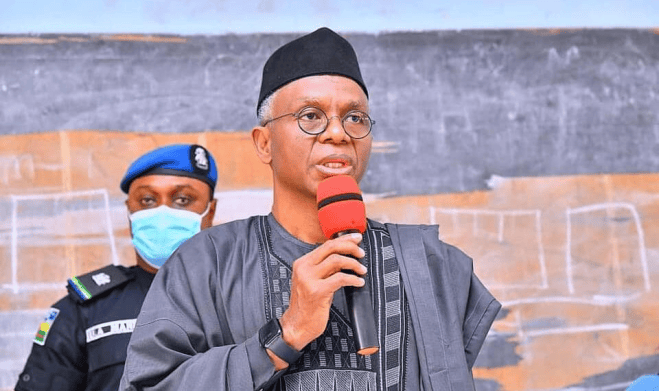
Controversial decisions
The religious dimension of his administration has remained equally contentious. In 2019, El-Rufai replaced his Christian deputy, Barnabas Yusuf Bala Bantex, with Hadiza Sabuwa Balarabe, a Muslim, creating a Muslim-Muslim ticket in a state where political arrangements had often sought to balance religious and regional interests.
El-Rufai later defended the decision as a political calculation. In a 2025 interview with Channels Television, he said his support for Muslim-Muslim tickets was “a political strategy” rather than a religious one.
But comments he made in a video in 2023 added fuel to the controversy. Explaining his choice of Balarabe, El-Rufai said he had calculated that many non-Muslims did not vote for his party and therefore saw little reason to give them the deputy governorship.
The arrangement continued under his successor until this year. El-Rufai also stated publicly his support for a similar arrangement at the national level, and his wish such an arrangement would continue.
In July 2026, Gov. Sani chose Jerry Adams, a Christian from Southern Kaduna, as his running mate for the 2027 election, ending the Kaduna APC’s Muslim-Muslim governorship ticket. Sani described the move as a reaffirmation of “inclusion, justice, fairness [and] equity.”
El-Rufai could not be reached for comment. He is currently in detention, facing trial in Abuja over allegations that he was involved in the unlawful interception of the telephone communications of National Security Adviser Nuhu Ribadu. In a separate case, the Independent Corrupt Practices and Other Related Offences Commission has charged him and others with alleged corruption, money laundering and related offences arising from a Kaduna State CCTV contract. El-Rufai has pleaded not guilty to the charges.
El-Rufai has previously defended his record as governor and rejected suggestions that his policies were designed to discriminate against Christians or deepen religious division.
Musa’s latest intervention therefore comes as Kaduna again enters a politically sensitive election cycle.
The Defence Minister said his criticism was not driven simply by his identity as a Kaduna native but by what he described as the broader national consequences of political leaders exploiting ethnic and religious differences.
He also accused El-Rufai of using state power against people with whom he had personal disagreements, including ordering the demolition of their houses.
“El-Rufai when he has personal issues with his friends, next thing, he sends bulldozers to pull down their houses,” Musa said. “He did a lot of things that I am sure he isn’t proud of.”
Discover more from Pluboard
Subscribe to get the latest posts sent to your email.